

Led classes are crucial. But why?
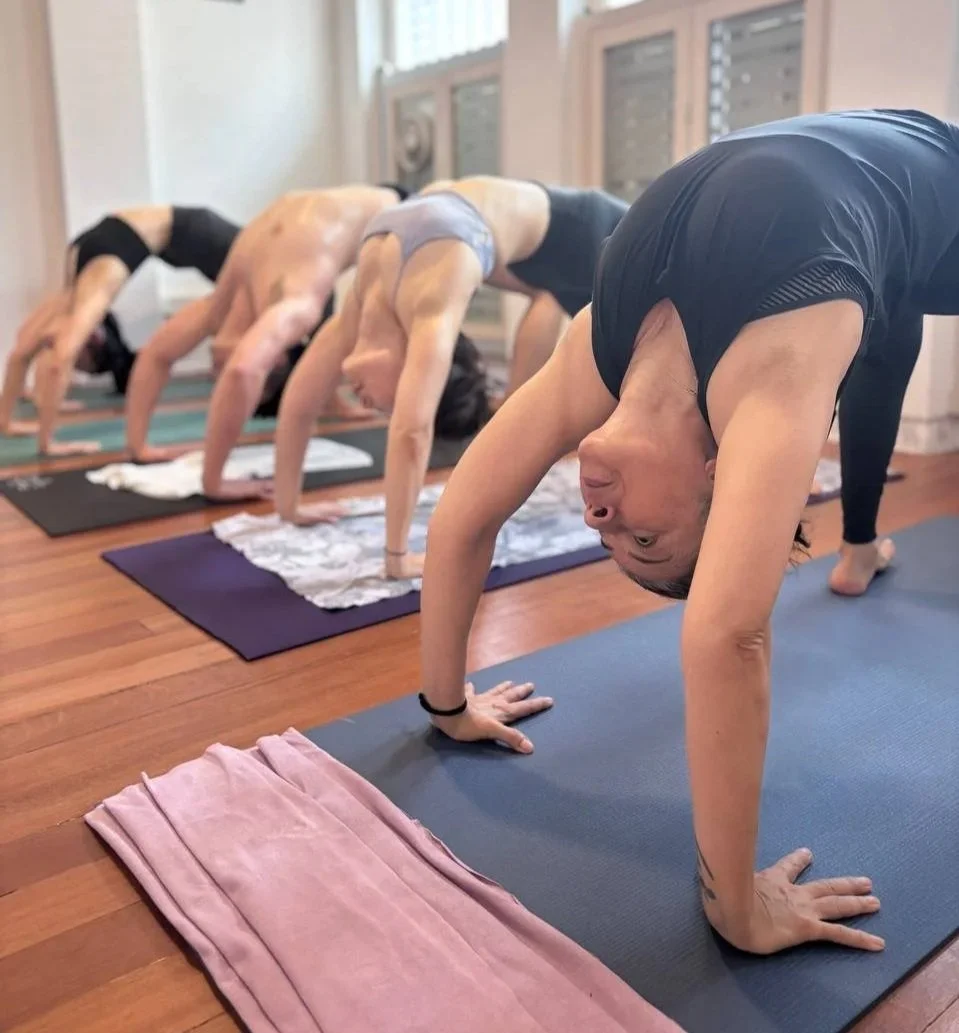
Mysore Practice – The Foundation
As yoga practitioner in Singapore, one who has discovered the beauty of the Mysore method, practicing at Mysore Breathing Room at with Sita is almost a default and natural choice. There are other teachers around, but the manner of how Sita lovingly holds the space, whilst balancing the need to let go just enough for me to deepen my practice safely, is a rare combination in a Mysore teacher.
Mornings for me, before I begin the day and venture into the world, are therefore, characterised by a routine which I would describe as—on a material level, both empowering and humbling—and on a subtle level, meditative and aligning. As I roll open my mat amidst the surrounding practitioners in an energetically charged room of intense focus, I feel a sense of gratitude at having found Mysore Breathing Room, this rare gem of a warm and welcoming place.
In the quiet a.m. before many of the newer students arrive, there’s little sound except for breath, movement, the occasional verbal cue. During these moments, I feel the world come to a standstill, and everything magically begins to make sense. In this space of palpable energy, the air hums with concentration, and the practice itself begins to communicate. In process of self-discovery, poses tell me about my internal state, vinyasas act as a prelude, a manner of invitation, for the next posture to take form—this entire process, as I move through the series, unfolds like a private dialogue between body, mind, and soul.
During one’s Mysore practice, it can be tempting at times to linger a little longer is a pose or rush through transitions. Certain habits—I shan’t label them good or bad—just habits, tend to find themselves forming. Finding what those are can be rather illuminating, and in the past for me, has highlighted a character defect that urgently needed attention.
The Led Class
An essential part of the practice
Even if goals may be, at this stage, just physical, at any level of practice, there’re quite limitless lessons which are quite frankly startling, which immediately fly into our faces upon incorporating the led class into the routine. I’m certain that no matter where a person is on their ashtanga journey, there will find something in attending led classes which do not and will not show up elsewhere: it shall reveal something within, something (more often than not) taking shape, and whilst you’re aware of its growing presence, it has yet to find a voice to communicate its intention in your life, and the truth of your being that getting acquainted with it shall forthwith bring.
Taking this in, upon hearing its call, it becomes your urgent, insuppressible priority, quite naturally and altogether rather suddenly.
To speak on things perhaps slightly more tangible, led classes teach me the rhythm of the practice, cultivating almost as a matter of course, strength, discipline and determination. When there’s no room to question in the mind, the body simply reacts to the instruction, and often I find myself getting into a pose at a level I didn’t think my body was capable of. Clearly, then the limitation had been my own mind, the doubt within, that had been holding me back from… what’s that word? Potential? No not even that. My mind held me back from what I could actually do…. imagine the grip it has on my potential? It’s scary actually, that our own minds can be the very limiting factor.
Sita’s steady cadence—her voice punctuating the count as she takes the class through the vinyasas and the poses—anchors the breath and movement into a unified rhythm. Practicing together, besides providing precision and sharpness in our practice, we are reminded that Ashtanga is not just a sequence of postures but a choreography of breath. The collective inhalations and exhalations weave into a tapestry, which forms a backdrop which facilitates deeper concentration in a journey towards dharana, all whilst simultaneously steadying the nervous system in a shared and unified resonance.
Building Collective Energy and Revealing One’s Blind Spots
There is a unique vitality in moving as one. In Mysore, the practice is personal; in led class, the practice is shared. The collective discipline amplifies energy in the room, carrying each practitioner through moments of fatigue or doubt. What feels solitary in self-practice becomes communal, and the shared effort cultivates a sense of sangha—community—that is as nourishing as the physical practice itself.
Also, though I touched on this briefly, I thought perhaps I need elaborate more. Led class, for me, can be mirror. Where Mysore allows freedom, led class exposes habits: the extra breaths, the skipped vinyasas, the unconscious shortcuts. Under Sita’s guidance, these blind spots surface gently but unmistakably. The structure of the class becomes a teacher in itself, sharpening awareness and refining technique. It is humbling, but also liberating, to see where discipline falters and where it can be strengthened.
Cultivating Surrender
Perhaps the greatest gift of led class is surrender. In Mysore, the practitioner carries responsibility for pacing and memory. In led class, that responsibility is released. We follow the count, and as always, trust the teacher, and allow ourselves to be carried by rhythm. This surrender is not a passive one. It has to be decided active, and decided given. In this practice of letting go, if one can do it truly and fully, one can begin to have the experience of yoga as a method of union, a tool to be utilised to move towards liberation.
A Complement to Self-Practice
For me, led class with Sita Chia is not a replacement for Mysore practice but its complement. It sharpens discipline, strengthens community, and reminds me of the roots of Ashtanga as a counted method. In the quiet mornings of Mysore, I cultivate independence; in the rhythmic count of the led class, I rediscover connection. With led classes, a person’s Mysore practice will eventually fizzle out. But together, one has a complete practice—one that balances introspection with synergy, self-discipline with surrender.